Quick Answer / Expert Engineering Verdict: Installing solar arrays on fragile clay, concrete, or Spanish S-tiles demands absolute structural clearance. A properly engineered installation utilizes specialized SUS304 stainless steel adjustable roof hooks that mount directly to the underlying wooden trusses. The critical engineering rule is that the hook must cantilever over the lower tile with a 6mm to 10mm clearance gap. If the metal hook rests on the tile, wind loads and thermal expansion will inevitably crack the ceramic, leading to severe roof leaks and massive EPC liability.
For residential and commercial developers, tile roofs represent a high-end architectural aesthetic. From terracotta Spanish tiles in California to heavy concrete flat tiles in Europe, these roofs are designed to last over 50 years. However, for Engineering, Procurement, and Construction (EPC) companies, they are often considered a logistical nightmare.
Unlike flat concrete or durable metal standing seams, clay and concrete tiles are inherently brittle. They cannot support the localized point-load of a solar racking system, nor can they withstand the foot traffic of a careless installation crew. A single cracked tile hidden beneath a solar panel can cause silent, devastating water damage to the building's interior, voiding warranties and ruining a solar company's reputation.
As a leading manufacturer of premium PV structural hardware, Xiamen Sunforson Power Co., Ltd engineers brackets designed to completely bypass the fragility of the roof surface. In this comprehensive technical guide, we will analyze the mechanics of tile failure, the geometry of adjustable roof hooks, and the exact protocols required to achieve a 100% waterproof, zero-damage tile roof solar installation.
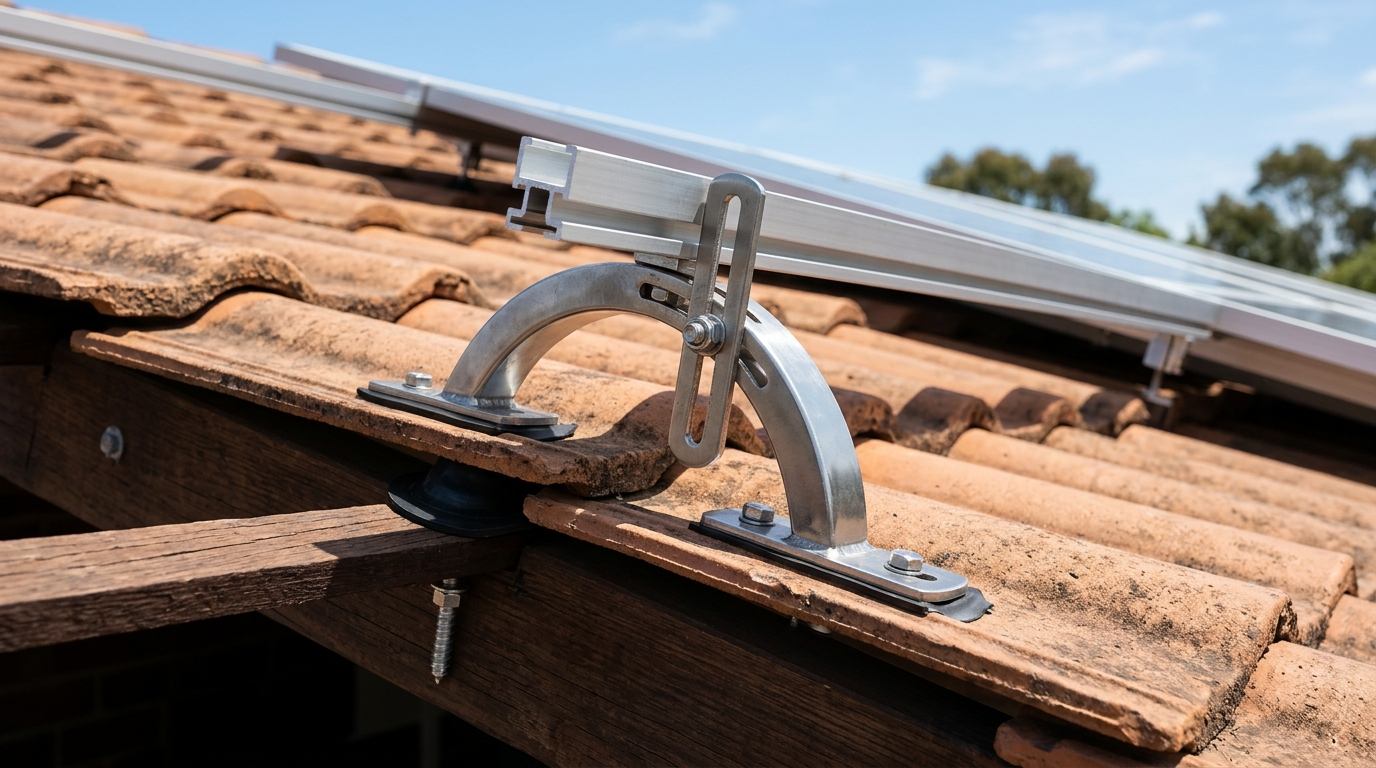
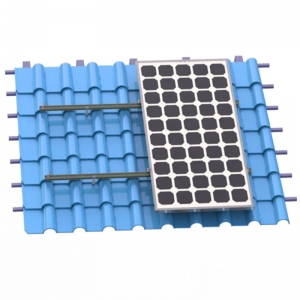
Figure 1: SunRack SUS304 adjustable roof hook maintaining structural clearance over a clay tile
1. The Anatomy of a Tile Roof Failure (Why Tiles Crack)
To prevent tile breakage, we must first understand the physics of how the damage occurs. Tiles do not typically break because the solar panels are too heavy (a standard solar array only adds about 15-20 kg/m² of dead load). They break because of compressive point-loading and dynamic friction.
When an inexperienced installer uses a generic, poorly shaped roof hook, the metal arm of the bracket often rests directly against the surface of the lower tile. When the wind blows, the massive surface area of the solar panels catches the aerodynamic drag. This wind force pushes down on the rails, which pushes down on the hook. If the hook is touching the tile, that thousands of Newtons of wind force acts like a hammer, instantly fracturing the ceramic.
The Structural Imperative: The solar racking system must be entirely supported by the building's structural rafters or trusses. The tiles themselves should bear absolutely zero weight from the PV array.
2. Engineering the Perfect Solar Roof Hook
To achieve this required separation, EPCs must specify highly specialized clay tile roof solar mounting hooks. Sunforson engineers these critical components with several non-negotiable features:
- High-Tensile SUS304 Stainless Steel: Roof hooks must survive in a highly oxygenated, moisture-rich environment beneath the tiles. We utilize SUS304 (or SUS316 for coastal zones) stainless steel, heavily bead-blasted for maximum anti-corrosion performance. Aluminum is generally not used for the base hook as it lacks the tensile yield strength to resist bending under heavy snow loads.
- Multi-Axis Adjustability: Roof rafters and wooden battens are rarely perfectly level, especially on older buildings. Sunforson provides 3-way adjustable roof hooks. Installers can slide the base plate left/right to hit the center of the rafter, adjust the neck up/down to match the exact thickness of the tile, and adjust the top L-bracket to perfectly level the horizontal aluminum rails.
- The 6mm Clearance Rule: The geometry of the hook must allow the arm to snake out from underneath the top overlapping tile and cantilever over the bottom tile. Installers must ensure a minimum physical gap of 6mm to 10mm between the stainless steel arm and the ceramic tile below it to absorb any structural deflection caused by heavy winds.
3. Waterproofing Protocols: Flashing and Base Plates
Even if you avoid breaking a tile, driving massive lag bolts into a wooden truss creates a penetration point in the roof deck (the underlayment).
When deploying a sloped tile PV mounting structure, standard roofing code dictates that silicone sealant alone is insufficient. Over decades of thermal expansion, silicone will degrade. EPCs should mandate the use of aluminum or galvanized steel roof flashing.
During installation, the roofer removes the tile, secures the stainless steel hook base plate directly to the rafter using heavy-duty wood screws (with EPDM washers), and then slides a sheet of metal flashing under the upper roofing felt and over the base plate. This ensures that any water driven by high winds that breaches the tiles will seamlessly run over the flashing and down the roof, rather than rotting the wooden trusses.
Technical Matrix: Matching the Hook to the Tile Profile
There is no "one-size-fits-all" solution in tile roofing. Utilizing the wrong hook geometry will force the installer to grind or cut excessive amounts of the tile, destroying its structural integrity. Sunforson manufactures dozens of specific dies to match regional architectures.
| Tile Profile Type | Architectural Characteristics | Required SunRack Hook Geometry |
|---|---|---|
| Flat Concrete Tile (Bramac) | Heavy, flat, and interlocking. Very little vertical space between overlapping layers. | Flat-neck stainless steel hooks (often requiring a minor notch to be ground into the underside of the top tile). |
| Spanish / Curved S-Tile | High undulating waves; highly brittle terracotta clay. | Deep "U-shaped" offset hooks designed to exit securely through the valley of the wave without touching the crest. |
| Slate / Shingle Tile | Extremely thin, dense stone layered tightly. Very prone to cracking if lifted. | Ultra-thin specialized slate hooks or solar flashing replacements that completely replace a section of the slate. |
4. Rail Span Optimization and Wind Uplift
Once the roof hooks are safely protruding from the tiles, the AL6005-T5 aluminum rails are attached. A critical engineering calculation for EPCs is the Rail Span (the distance between two roof hooks).
If an installer attempts to save money by spacing the roof hooks too far apart (e.g., every 2 meters in a hurricane zone), the aluminum rail will flex violently under heavy wind loads. This deflection will cause the rails to bounce, transferring chaotic kinetic energy into the solar panels and potentially causing micro-cracks in the photovoltaic cells. When supplying commercial rooftop solar bracket solutions, Sunforson's structural engineering team runs site-specific FEA (Finite Element Analysis) to dictate the exact hook spacing based on local ASCE 7 or AS/NZS 1170.2 wind codes, ensuring the rails remain entirely rigid.
Frequently Asked Questions (FAQ) for Tile Roof Solar Installations
Q1: Do I need to grind or cut the tiles to fit the roof hook?
It depends on the tile. For high-profile Spanish S-tiles, a properly shaped hook will snake through the valley without any cutting. For tight, flat concrete tiles, installers often must use an angle grinder to shave a small notch (recess) into the underside of the top tile. This allows the tile to sit perfectly flat over the stainless steel bracket arm without being jacked up into the air.
Q2: Can I use lag bolts directly into the roof decking (plywood) instead of the rafters?
No. The thin plywood (OSB) sheathing beneath the tiles does not possess the structural pull-out strength required to resist aerodynamic wind uplift. Roof hook base plates must be secured directly into the heavy wooden structural rafters (trusses) using deep-penetrating lag screws.
Q3: Why are Sunforson's roof hooks shot-blasted (bead-blasted)?
Shot-blasting is an advanced metallurgical surface treatment. It removes all impurities, welding slag, and microscopic burrs from the stainless steel, leaving a uniform, matte finish. This process significantly enhances the passivation layer of the steel, providing vastly superior anti-corrosion performance compared to cheap, raw steel hooks.
Protect the Roof, Secure the Array
Tile roofs require precision engineering, not guesswork. Do not risk your EPC firm's liability by utilizing generic, non-adjustable hardware that cracks tiles and invites water damage. Partner with Xiamen Sunforson Power Co., Ltd for roof hooks mathematically customized to your specific architectural profile.
Send us a photo and dimensioned cross-section of your roof tiles for a free hardware matching analysis:
info@sunforson.com